The phone rings and your hands are busy
A facial, a laser session or microblading cannot be paused to take a call. What happens to the calls you miss, and the options you have for not losing them.
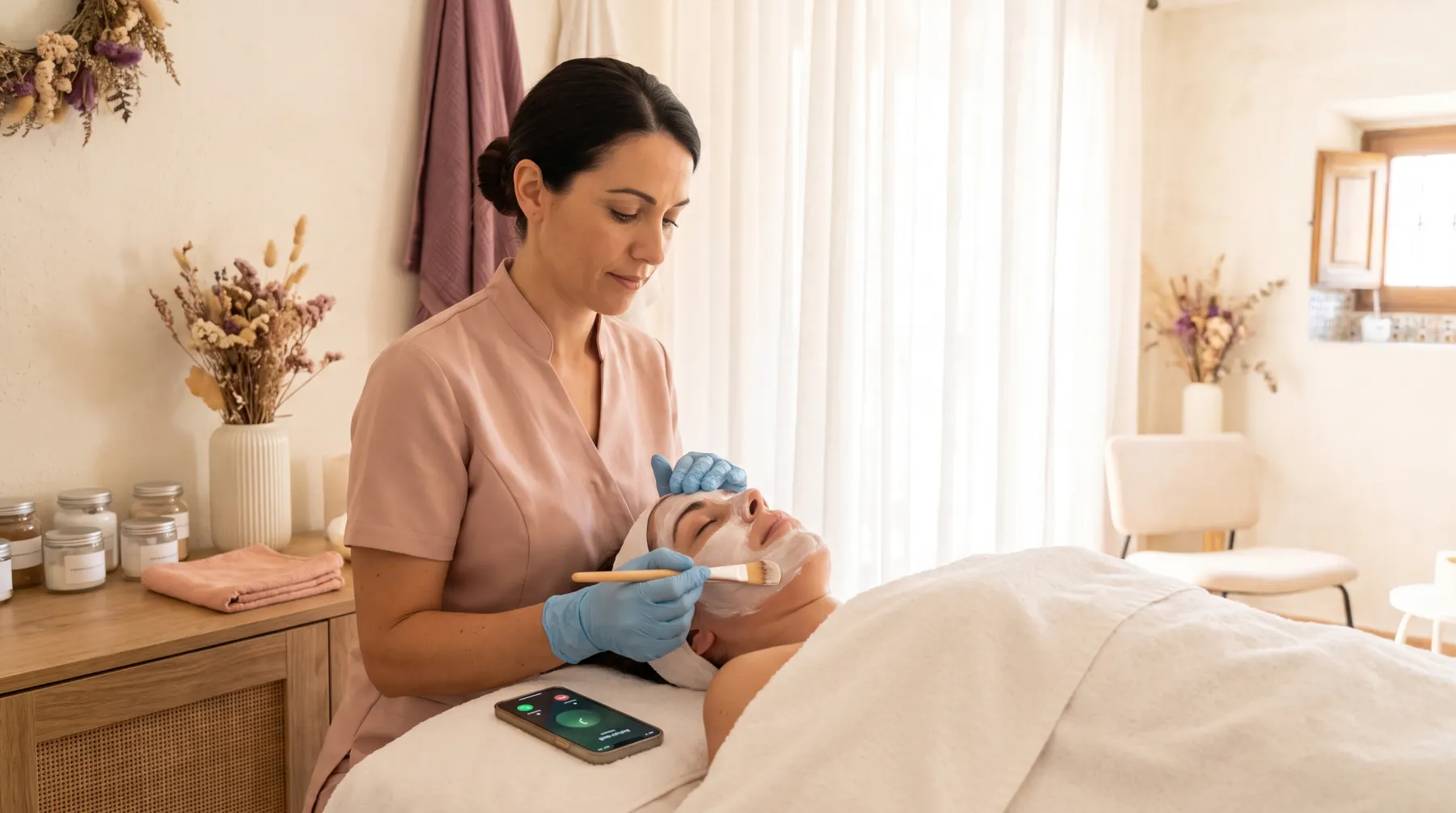
You are halfway through a microblading session. You are wearing gloves, the client is lying back, the pigment is on the needle and your hand cannot move. Your phone buzzes on the tray. You glance at it: an unknown number. You know what it is: someone who has never met you and wants to know what something costs and whether you have a slot this week. You cannot answer. By the time you finish, an hour from now, they will already have rung another centre.
This is not a rare anecdote. It is an ordinary day for anyone who works with their hands: facials, lasers, waxing, nails, lashes, body treatments. What you sell is your focused time, and there is no honest way to offer that and answer the phone at the same time. Anyone with a receptionist never feels this. Anyone working alone, or with a colleague who is just as busy, feels it several times a week. This article has no numbers about how many calls the industry loses, because we have not measured that and we are not going to invent it. It offers something more useful: what the problem looks like from the inside and what you can do about it.
Why this is not a problem of organisation
The usual advice is 'set aside a time to return calls'. It is fine and it does not solve the essential part. Someone ringing to ask a price does not wait: while you are with a client, they open the search engine, see the next centre and dial. The call you return at two in the afternoon reaches a person who has already booked elsewhere, or has forgotten about it, or no longer has the curiosity they had three hours earlier. The useful window for a first enquiry is short, and it closes exactly when you cannot reach the phone.
Nor is it a matter of discipline. It is not that you do not want to answer: it is that answering halfway is worse. If you take the call with a client on the couch, the client with you notices, the caller hears background noise and the conversation goes badly for both of them. And if you handle calls while you work, the session overruns. What most people do is let it ring, and the cost is invisible: you never know which call was a new client and which was a salesperson.
The same four scenes, again and again
- During a treatment: gloves on, product on your hands, the client in front of you. There is simply no way.
- After a treatment: you come out at two o'clock to several calls you did not take, a message or two and a few Instagram notifications. Returning them all eats the only break you had.
- Outside opening hours: the person who decides in the evening or on Sunday what they will do on Saturday. If nobody answers, they do not leave a message, they book wherever someone does.
- In another language: on the coast, clients ring who speak English or German. If they are not understood the first time, they hang up without a second thought.
None of the four is fixed by trying harder. They are fixed by someone, or something, picking up the phone for you while your hands stay where they are.
What people usually try, and where it falls short
- Letting it ring and calling back later: it is free and it is what almost everyone does. You lose the window of the first enquiry and you return calls during your break.
- A voicemail greeting with your opening hours: it informs, but hardly anyone leaves a voicemail these days.
- A booking app with your diary: it lets a client book on her own once she knows what she wants. It does not answer someone who still has a question ('how long does it take?', 'can I have it done the same day as my nails?') or someone who rings instead of opening an app.
- A part-time receptionist: it works and it costs what a person costs. For a centre with a single professional it rarely adds up.
- A text auto-reply on your website: it answers people who write, not people who call.
What it takes to solve it properly
Thinking about your own case, what the problem asks for is small and specific. Someone has to answer by voice, because a person ringing does not want to type. That someone has to know what you charge and how long each treatment takes, so the answer is useful and not a 'we will call you back'. It has to say clearly that it is an artificial intelligence and that the conversation is recorded, because that is the honest thing to do and what the regulation requires. It should send the client to your usual booking link instead of trying to replace your diary. And you should be able to listen afterwards to what was said, so you can trust it.
That is what BeautySuite does, and also what it does not do: it does not book appointments, it does not touch your diary and it does not replace Booksy or Treatwell. We have one article that explains how the voice call works from your website and your Instagram bio, and another about the recordings, which are what let you check that the front desk is doing its job. If you would rather first see what other tools exist and what each one does, there is a summary below and a comparison with each of them.